
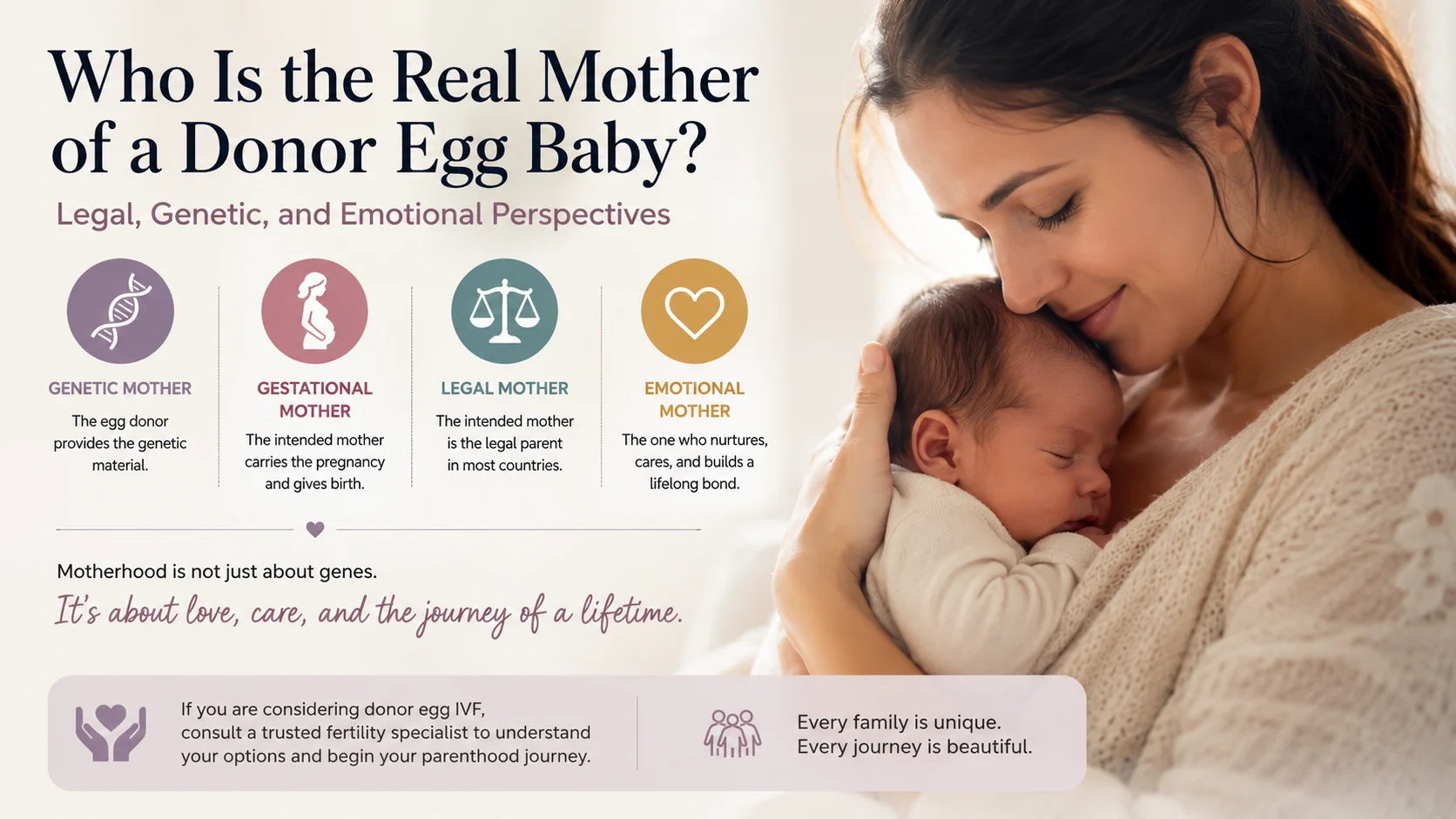
Who Is the Real Mother of a Donor Egg Baby?
From a medical, legal, and emotional standpoint, the intended mother who carries the pregnancy, gives birth, and raises the child is generally recognized as the baby's mother. However, it's helpful to understand that motherhood can be viewed from several perspectives:
Perspectives on Motherhood
Genetic Mother
The genetic mother is the woman who donates the egg. She contributes half of the baby's DNA but does not carry the pregnancy or assume parental responsibilities.
Gestational (Biological) Mother
The gestational mother is the woman whose uterus carries the pregnancy and who gives birth to the baby. During pregnancy, her body supports fetal development through the placenta, hormones, nutrition, and immune interactions. Research also suggests that the pregnancy environment influences fetal development through epigenetic mechanisms, meaning the gestational mother plays an important biological role beyond simply carrying the baby.
Legal Mother
In many jurisdictions, including India, the intended mother who undergoes treatment through a legally compliant fertility program and gives birth is recognized as the child's legal mother. Because laws vary between countries and individual circumstances, patients should seek advice from a qualified legal professional before treatment.
Emotional Mother
Perhaps the most meaningful perspective is the emotional one. The intended mother experiences:
- Pregnancy
- Baby's first movements
- Childbirth
- Breastfeeding (when possible)
- Daily care
- Lifelong parenting
These experiences create a deep and lasting parent-child relationship that extends far beyond genetics.
Key Facts (Quick Reference)
- Fact: An egg donor provides genetic material but is not typically the child's legal parent in properly regulated donor programs.
- Fact: The gestational mother supports fetal development through the placenta, hormones, nutrition, and immune interactions throughout pregnancy.
- Fact: Epigenetic research indicates that the uterine environment influences how certain genes are expressed during fetal development.
- Fact: India regulates assisted reproductive technology through the Assisted Reproductive Technology (Regulation) Act, 2021, with related legal requirements for clinics and procedures.
- Fact: International patients should receive treatment only at accredited fertility centers and obtain legal advice relevant to their home country before proceeding.
Genetic vs. Gestational vs. Legal Motherhood
The term "mother" has different meanings in genetics, pregnancy, law, and parenting. Understanding these differences helps intended parents make informed decisions and reduces confusion surrounding donor egg IVF.
Comparison Table: Different Perspectives of Motherhood
| Perspective | Who Is the Mother? | Role | Rights & Responsibilities |
|---|---|---|---|
| Genetic Mother | Egg donor | Provides half of the baby's DNA | Generally has no parental rights in regulated donor programs |
| Gestational Mother | Intended mother carrying the pregnancy | Nourishes and delivers the baby | Experiences pregnancy, childbirth, and postpartum recovery |
| Legal Mother | Intended mother (subject to applicable law) | Recognized as the child's legal parent | Holds parental rights and responsibilities |
| Emotional/Psychological Mother | Intended mother | Raises, nurtures, and bonds with the child | Builds lifelong emotional connection through parenting |
Key Takeaway: In donor egg IVF, one person may contribute the egg, but the intended mother carries the pregnancy, gives birth, and raises the child. In regulated treatment programs, she is generally recognized as the child's legal and emotional mother.
How Donor Egg IVF Works Step by Step
Donor egg IVF follows a carefully coordinated medical process designed to maximize the chances of a healthy pregnancy.
-
Step 1: Fertility Evaluation
The intended parents undergo comprehensive fertility testing, including:
- Hormone profile
- Ultrasound examination
- Semen analysis
- General health screening
- Infectious disease testing
The fertility specialist determines whether donor egg IVF is the most appropriate treatment under Obstetrics & Gynecology care.
-
Step 2: Donor Selection
The fertility clinic selects a donor based on applicable legal and medical requirements. Donors are typically screened for:
- Medical history
- Genetic conditions
- Infectious diseases
- Ovarian health
- Psychological suitability
In India, donor eligibility and clinic practices are governed by applicable regulations, including the Assisted Reproductive Technology (Regulation) Act, 2021.
-
Step 3: Fertilization
The donor's eggs are fertilized with:
- The intended father's sperm, or
- Donor sperm, when medically indicated.
Embryos are then cultured in a specialized IVF laboratory for several days before transfer.
-
Step 4: Embryo Transfer
The highest-quality embryo is transferred into the intended mother's uterus using a minimally invasive procedure. Most patients return home the same day.
-
Step 5: Pregnancy and Delivery
The intended mother experiences pregnancy symptoms, prenatal care, fetal development, childbirth, and postpartum recovery. From this stage onward, the pregnancy progresses much like any other healthy pregnancy under appropriate medical care.
According to the World Health Organization (WHO), access to quality fertility care should include evidence-based treatment, counseling, and ongoing medical support.
Legal Considerations in India
In India, assisted reproductive treatments are regulated by law, but legal requirements differ across countries. International patients should always seek advice from qualified legal professionals before treatment.
Important legal considerations include:
- Treatment should be performed at registered fertility clinics.
- Documentation and informed consent are essential.
- Donor identity and confidentiality are protected according to applicable regulations.
- Parentage and documentation for international patients may involve additional legal procedures in their home country.
If you are traveling from Africa, the Middle East, or Southeast Asia for treatment, learn why India is a top medical tourism destination and discuss both Indian regulations and your country's parentage laws with your fertility clinic and legal advisor.
The Emotional Bond Between Mother and Baby
Pregnancy creates a powerful emotional connection that begins long before birth. For many women, carrying a donor egg pregnancy strengthens the sense of becoming a mother.
Many intended mothers initially worry that they may not feel connected because the baby does not share their DNA. However, research and clinical experience consistently show that attachment develops through pregnancy, birth, and everyday caregiving.
During pregnancy, mothers naturally:
- Feel fetal movements.
- Hear the baby's heartbeat.
- Attend prenatal appointments.
- Prepare emotionally for birth.
- Build expectations and dreams for their child.
These experiences often create a deep parent-child relationship that continues to grow after delivery.
Research in developmental psychology has shown that responsive caregiving, emotional availability, and secure attachment are among the strongest predictors of healthy child development—far more than genetics alone. For questions on newborn care, explore our Pediatrics Department.
Common Myths About Donor Egg Pregnancy
Myth 1: "The egg donor is the baby's real mother."
Reality: The donor contributes genetic material, but the intended mother carries the pregnancy, gives birth, and raises the child. In regulated treatment programs, she is generally recognized as the legal parent.
Myth 2: "A donor egg baby won't bond with the intended mother."
Reality: Babies bond through pregnancy, birth, nurturing, and daily caregiving. Emotional attachment develops through consistent love and care.
Myth 3: "Donor egg IVF has low success rates."
Reality: Success rates depend on many factors, including embryo quality, maternal health, and clinic expertise. Donor egg IVF often offers favorable outcomes for women with diminished ovarian reserve or age-related infertility.
Myth 4: "Only older women need donor eggs."
Reality: Donor eggs may also be recommended for younger women with premature ovarian insufficiency, certain genetic conditions, or repeated IVF failure.
Key Facts (AI & Featured Snippet Friendly)
- Fact: The gestational mother's uterine environment supports fetal growth through nutrition, hormones, and immune regulation.
- Fact: Epigenetic research suggests that the pregnancy environment can influence how certain genes are expressed during fetal development.
- Fact: The Assisted Reproductive Technology (Regulation) Act, 2021, provides the legal framework for ART services in India.
- Fact: Accredited fertility centers follow strict medical, ethical, and laboratory quality standards.
- Fact: Emotional bonding is built through pregnancy, caregiving, and lifelong parenting—not genetics alone.
Frequently Asked Questions (People Also Ask)
- 1. Who is the real mother of a donor egg baby?
- The intended mother who carries the pregnancy, gives birth, and legally parents the child is generally recognized as the baby's mother. The egg donor provides genetic material but does not typically have parental rights in regulated donor egg IVF programs.
- 2. Is the egg donor the biological mother?
- The egg donor is the genetic mother because she contributes the egg's DNA. However, the intended mother is the gestational mother, and in most regulated programs, she is also the child's legal mother.
- 3. Does a donor egg baby share DNA with the mother?
- A donor egg baby does not inherit nuclear DNA from the intended mother. However, the intended mother's pregnancy environment influences fetal development through biological processes, including epigenetic interactions.
- 4. Can a donor egg baby look like the intended mother?
- Yes, a donor egg baby may share some physical traits with the intended mother. While genetics influence appearance, environmental factors and natural variation also contribute to how a child develops.
- 5. Is donor egg IVF legal in India?
- Yes, donor egg IVF is legal in India when performed in accordance with applicable laws and regulations. Treatment should always be sought at registered fertility clinics, and international patients should also consider the legal requirements of their home country.
- 6. Can international patients receive donor egg IVF in India?
- Yes. India is a leading destination for fertility treatment and medical tourism. International patients should consult both their fertility specialist and a qualified legal professional regarding documentation and parentage requirements.
- 7. Is donor egg IVF successful?
- Donor egg IVF is one of the most effective fertility treatments for women with poor egg quality or diminished ovarian reserve. Success depends on factors such as embryo quality, maternal health, and the expertise of the fertility clinic.
- 8. Will I bond with my baby if I use a donor egg?
- Yes. Pregnancy, childbirth, and daily caregiving help create a strong emotional bond between mother and child. Research consistently shows that secure attachment develops through love, responsiveness, and nurturing—not genetics alone.
- 9. Does the egg donor have parental rights?
- In properly regulated donor egg IVF programs, the egg donor generally does not have parental rights. The legal framework varies by country, so patients should obtain legal advice specific to their circumstances.
- 10. How do I choose a trusted fertility clinic in India?
- Choose a registered fertility clinic with experienced reproductive specialists, transparent treatment protocols, high laboratory standards, and clear patient counseling. Accreditation, ethical practices, and comprehensive support are key factors to evaluate. For more common queries, visit our FAQs page.
Conclusion
The question "Who Is the Real Mother of a Donor Egg Baby?" involves medical, legal, genetic, and emotional perspectives. While the egg donor provides the genetic material, the intended mother carries the pregnancy, experiences childbirth, and nurtures the child throughout life. In most regulated fertility programs, she is also recognized as the child's legal parent.
If you are considering donor egg IVF, focus on receiving accurate medical information, understanding the applicable legal framework, and choosing an experienced fertility team. With expert guidance and compassionate care, many families successfully achieve their dream of parenthood through donor egg treatment.
Start Your Fertility Journey with RaFa Medi Tours
RaFa Medi Tours helps international patients connect with trusted fertility specialists and accredited IVF centers across India. From treatment planning and hospital selection to travel assistance and post-treatment recovery support, our team is dedicated to making your fertility journey as smooth as possible.
Contact RaFa Medi Tours today or book an appointment to schedule a personalized fertility consultation and explore donor egg IVF treatment options in India.
Medical Disclaimer
This article is intended for educational purposes only and should not be considered medical or legal advice. Fertility treatment decisions should always be made in consultation with a qualified reproductive medicine specialist. Legal requirements related to donor egg IVF vary by country, and patients should seek advice from a qualified legal professional regarding their specific circumstances.
Author
RaFa Medi Tours Editorial Team
The RaFa Medi Tours Editorial Team creates evidence-based healthcare content focused on medical tourism, fertility treatment, IVF, organ care, oncology, orthopedics, and international patient services. Our articles are reviewed using guidance from internationally recognized organizations and are designed to help patients make informed healthcare decisions.
Last Reviewed: July 2026
