
What Is the Riskiest Heart Surgery? | High-Risk Cardiac Guide
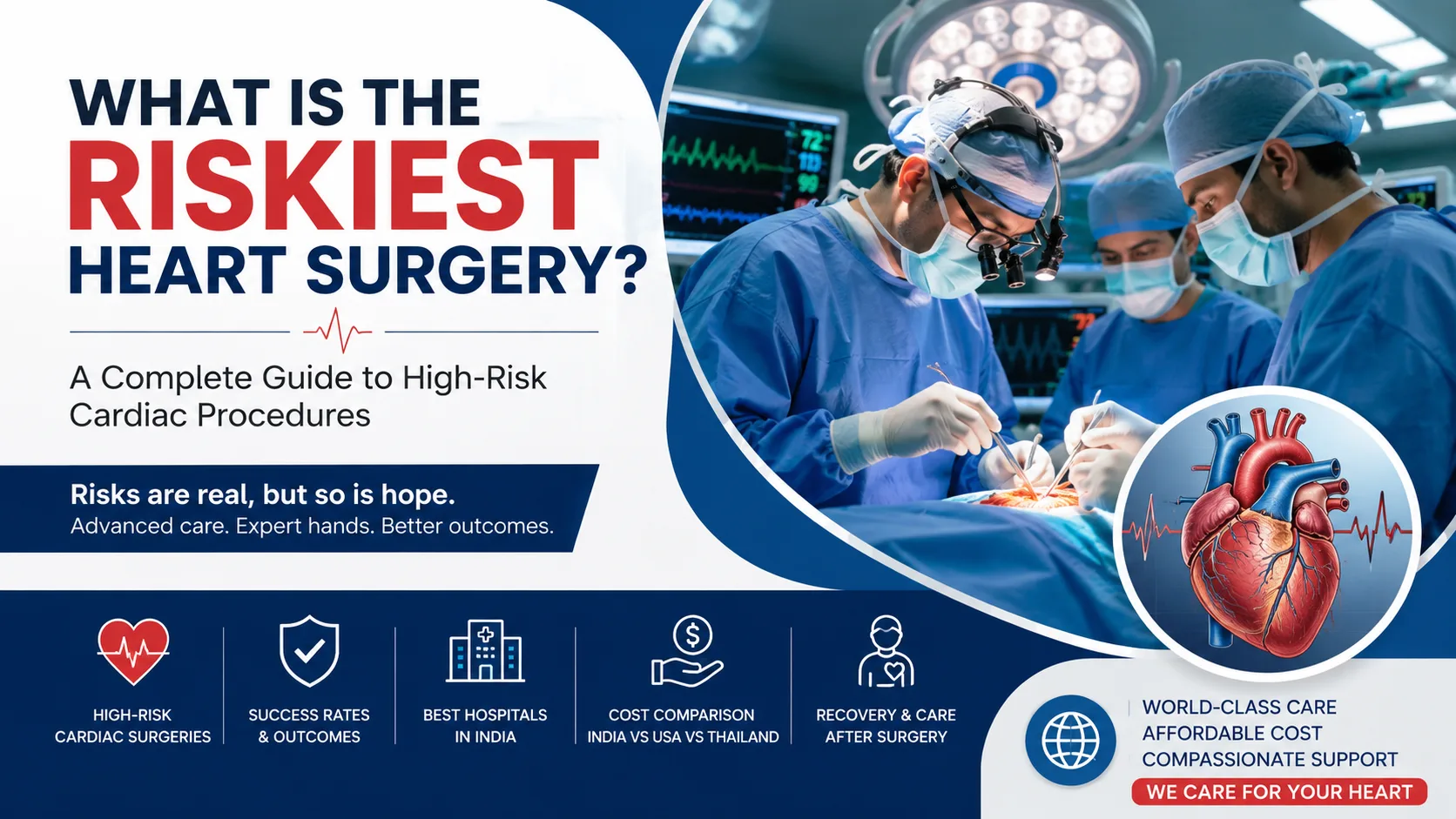
What Is the Riskiest Heart Surgery? | High-Risk Cardiac Guide
What Is the Most High-Risk Heart Surgery? A Complete Guide
Understanding complex cardiac surgery, why some operations carry more risk than others, and how international patients find safe, affordable treatment in India.
Introduction
Hearing that you or a loved one needs heart surgery is frightening. It's natural to ask how dangerous the operation really is, what the chances of survival are, and where to find the safest possible care. This is especially true for the many patients from Kenya, Uganda, Tanzania, Zambia, the DR Congo, Mauritius, Mozambique, the Middle East, and South Asia who research their options carefully before making a life-changing treatment decision.
The good news: a "high-risk" label does not mean an operation is unsurvivable. Advances in surgical technique, imaging, heart-lung bypass technology, and minimally invasive methods have steadily improved outcomes for procedures once considered extremely dangerous. India has become one of the world's leading destinations for complex cardiac care, combining internationally trained specialists, modern hospital infrastructure, and treatment costs far below those in the US, UK, or Gulf countries.
This guide explains which cardiac procedures are considered highest-risk, why, who typically needs them, what recovery involves, what they cost, and how RaFa Medi Tours supports international patients through the process.
What Makes a Heart Surgery "High-Risk"?
Cardiac surgery is classified as high-risk when the patient's overall health, the technical complexity of the procedure, or the urgency of the operation increases the chance of serious complications. High-risk procedures typically involve the aorta, multiple heart valves, or several combined interventions performed at once.
Surgeons weigh factors such as the patient's age, heart muscle function, diabetes, kidney disease, prior cardiac surgery, and whether the operation is planned or an emergency. Before any major operation, patients are assessed using internationally recognized scoring tools — such as EuroSCORE II and the STS Risk Calculator — which help the surgical team estimate risk and plan accordingly.
Common reasons an operation is classified as high-risk:
- Emergency presentation (no time for extensive pre-operative preparation)
- Severe heart pump failure
- Multiple blocked coronary arteries
- Involvement of the aorta
- Repeat ("redo") surgery after a previous cardiac operation
- Reduced heart muscle function
- Advanced age
- Kidney or lung disease
- Replacement of more than one heart valve
What Is the Most High-Risk Heart Surgery?
Among all cardiac procedures, surgery for acute aortic dissection — particularly Type A dissection — is widely regarded as one of the most dangerous and technically demanding operations in cardiac surgery. It happens when the inner wall of the aorta (the body's main artery) tears, allowing blood to force its way between the layers of the vessel wall. Without immediate surgery, the condition is frequently fatal, which is why it is treated as a true surgical emergency.
During the operation, surgeons must:
- Temporarily stop blood circulation through the affected section
- Repair or replace the damaged portion of the aorta
- Protect the brain while circulation is interrupted
- Restore normal blood flow to the organs
- Manage major swings in blood pressure throughout the procedure
Because these operations are almost always performed as emergencies rather than planned procedures, they carry more risk than scheduled surgery. Published data on Type A aortic dissection repair puts in-hospital mortality in a broad range of roughly 5–20%, and higher still for redo aortic arch surgery or cases involving the aortic root — reflecting just how much urgency and anatomical complexity affect outcome.
Other Complex Cardiac Surgeries Beyond Aortic Repair
Heart transplant
A heart transplant replaces a failing heart with a donor organ. The operation itself is highly complex, but long-term success depends heavily on preventing organ rejection and lifelong management of immunosuppressive medication. Survival outcomes for modern heart transplantation continue to improve with careful post-transplant follow-up.
Multiple valve replacement surgery
Patients with damage to more than one heart valve may need two valves replaced in the same operation. Complexity increases because surgeons must restore normal blood flow through several repaired structures while keeping overall heart function stable throughout.
Redo (repeat) cardiac surgery
A second heart operation is usually more difficult than the first, because scar tissue forms around the heart after the initial surgery. Previous grafts, implanted devices, and altered anatomy all add to the surgical risk.
Combined CABG and valve surgery
Some patients need coronary artery bypass grafting (CABG) together with valve repair or replacement. Rather than one operation, surgeons effectively perform two major procedures under a single anesthetic, which extends surgery time and increases recovery demands. This combination is often cited as carrying among the highest average risk of any elective cardiac procedure.
Adult congenital heart surgery
Adults born with complex congenital heart defects sometimes require surgical correction later in life. These cases call for specialists trained specifically in congenital cardiac anatomy, since every patient's structure is different.
Why Do Patients Need Complex Heart Surgery?
High-risk cardiac surgery is only recommended when the expected benefit clearly outweighs the risk — that is, when less invasive treatment can no longer protect the patient's life or heart function. Conditions that commonly lead to this point include:
- Severe coronary artery disease, where blocked arteries starve the heart muscle of blood
- Aortic aneurysm — a weakened, enlarged section of the aorta that can rupture if untreated
- Aortic dissection, where surgery is often the only life-saving option
- Serious valve disease that prevents efficient blood circulation
- End-stage heart failure, where mechanical support or transplant may be the only remaining option
Factors That Increase Surgical Risk
Overall risk depends less on the type of operation alone and more on the individual patient. Key risk factors include:
| Risk Factor | Why It Matters |
|---|---|
| Age over 70 | Slower recovery, more coexisting conditions |
| Diabetes | Slower wound healing, higher infection risk |
| Chronic kidney disease | Complicates fluid and medication management |
| Lung disease | Higher risk during and after anesthesia |
| Smoking history | Impaired healing and lung function |
| Obesity | Added strain on the cardiovascular system |
| Previous cardiac surgery | Scar tissue increases technical difficulty |
| Weakened heart muscle | Less reserve to tolerate the operation |
| Emergency setting | No time for full pre-operative optimization |
| Uncontrolled hypertension | Raises risk of bleeding and vessel injury |
| Active infection | Raises risk of post-surgical complications |
Leading hospitals reduce these risks through multidisciplinary teams — cardiologists, cardiac surgeons, anesthetists, intensivists, dietitians, and rehabilitation specialists working together on each case.
India vs USA vs Thailand: Cost Comparison
Cardiac surgery is consistently one of the top reasons patients travel abroad for treatment, largely because of the cost difference. Reported figures vary by hospital and procedure, but the general pattern is consistent:
| Procedure | Typical Cost — USA | Typical Cost — India |
|---|---|---|
| Coronary artery bypass (CABG) | $120,000 – $400,000+ | roughly $5,000 – $10,000 |
| Heart valve replacement | $150,000+ | roughly $6,000 – $12,000 |
| Angioplasty with stent | $40,000 – $47,000+ | roughly $3,000 – $4,500 |
| Robotic bypass surgery | $30,000 – $50,000 | roughly $7,500 – $14,500 |
Overall, patients commonly report savings of 70–90% by choosing India over the US for cardiac procedures, without a reduction in surgical quality at accredited hospitals. Thailand offers a comparable clinical standard but at a higher price point, largely due to its more upscale, hospitality-focused hospital model.
Leading Cardiac Hospitals in India
India performs a very high volume of complex cardiac procedures each year, with many hospitals accredited by the Joint Commission International (JCI) or the National Accreditation Board for Hospitals & Healthcare Providers (NABH) — the same standards used to benchmark hospital quality internationally. High surgical volume, in cardiac care, generally correlates with more experienced teams and more consistent outcomes.
How RaFa Medi Tours Helps International Patients
Traveling abroad for heart surgery involves more than choosing a hospital. RaFa Medi Tours supports international patients through each stage of the journey:
- Matching patients with accredited cardiac hospitals and specialists suited to their specific condition
- Coordinating medical visa documentation, including country-specific guidance for patients from Zambia, Uganda, and the DR Congo
- Providing transparent treatment cost estimates before travel
- Arranging accommodation, local transport, and interpreter support where needed
- Coordinating post-operative follow-up and recovery planning
For related reading, see why many patients are turning to medical tourism in general, and how India compares on cost across specialties in affordable medical tourism in India.
Considering complex cardiac surgery abroad? Talk to our care coordinators for a personalized treatment plan and cost estimate.
Contact RaFa Medi ToursFrequently Asked Questions
What is considered low-risk cardiac surgery?
Planned, isolated procedures in otherwise healthy patients — such as a single valve repair or bypass in a younger patient with good heart function — generally carry the lowest risk, often in the range of 1–4% mortality.
What is the most dangerous heart surgery?
Emergency repair of acute aortic (Type A) dissection is generally considered the highest-risk cardiac operation, given the speed required and the anatomical complexity involved.
What is the survival rate of high-risk cardiac surgery?
It varies significantly by procedure and patient health, but with modern surgical technique and post-operative care, the majority of patients survive even complex operations — particularly when treated promptly at an experienced center.
Conclusion
A high-risk classification reflects the complexity of an operation and the patient's individual health profile — not a guaranteed poor outcome. With prompt diagnosis, an experienced surgical team, and appropriate post-operative care, even the most complex heart surgeries have improved substantially in safety over the past decade. For international patients weighing cost, quality, and access, India's accredited cardiac centers — paired with dedicated support from a facilitator like RaFa Medi Tours — offer a practical path to world-class treatment.
This article is for general informational purposes only and does not constitute medical advice. Mortality and cost figures are approximate ranges drawn from published clinical literature and industry sources, and will vary by hospital, surgeon, and individual patient condition. Always consult a qualified cardiac specialist for diagnosis and treatment planning.
